
Best GPU for gaming – My best graphics cards 2024 tier list
Here are my favourite graphics cards, no matter the budget

Share this article...

WePC is reader-supported. When you buy through links on our site, we may earn an affiliate commission. Prices subject to change. Learn more
Looking for the best GPU in 2024? Then you have come to the right place. We have tons of experience in PC gaming to know what to expect from the cards and manufacturers, so you’re in good hands. Our team of dedicated PC enthusiasts is constantly reviewing, benchmarking, and comparing the latest graphics cards so you don’t have to.
We keep this page constantly updated with the latest products. We’ll be comparing price, performance, aesthetics, and cooling, ensuring our selection is the best overall value-for-money products you can buy. Right now the best graphics card on the market is Nvidia’s RTX 4090 from Nvidia, which we have reviewed extensively and can highly recommend if you’re after a truly powerful graphics card. However, Nvidia fans may also want to seriously consider the newer 4080 Super, which offers plenty of power. In the red corner, AMD’s Radeon RX 7900 XTX, is our pick of what AMD has to offer. Now, let’s help you fi nda new graphics card.
-
 01Best graphics card
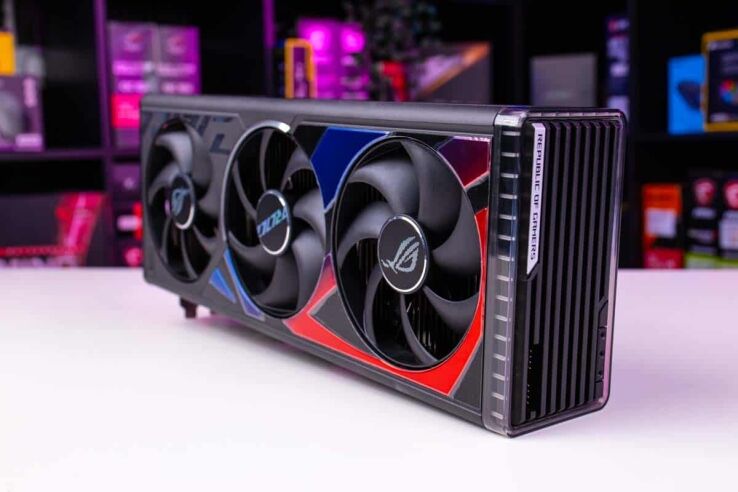
ASUS ROG Strix RTX 4090 OC
- 02Runner up best

MSI Gaming GeForce RTX 3080 Gaming X Trio 10G
-
 03Best AMD graphics card


Best GPU deals
- Sapphire Pulse AMD Radeon RX 7900 XTX – Save $360 now!
- Sapphire Nitro+ AMD Radeon RX 7900 XTX Vapor-X Gaming Graphics Card – Save $380 now!
- MSI Gaming GeForce RTX 4070 Ti 12GB GDRR6X – Save 7% NOW!
- XFX Speedster SWFT319 Radeon RX 6800 Core Gaming Graphics Card – Save 13% NOW!
- ZOTAC Gaming GeForce RTX 4070 Ti Trinity OC – Save $100 NOW!
- MSI Gaming GeForce RTX 3090 – Save 37% NOW!
- GIGABYTE GeForce RTX 3060 Gaming OC – Save $130 NOW!
- XFX Speedster MERC310 AMD Radeon RX 7900XTX Black Gaming Graphics Card – Save 8% NOW!
- MSI Gaming GeForce RTX 4080 – Save 12% NOW!
- MSI Gaming GeForce RTX 4070 Ti – Save $105 NOW!
Best graphics cards 2024
ASUS ROG Strix RTX 4090 OC

Core Clock Speed
2,640 MHz boost
CUDA Cores
16,384
Memory Size
24GB GDDR6X
Dimensions
357.6 x 149.3 x 70.1mm
PSU Required
1000W
TDP
450W


- Excellent air cooling solution
- Pushes performance above the rest of the selection
- Updated design cooling and aesthetically focused
- A more expensive choice over the rest of the picks and will cost a lot to run
The RTX 4090 is more than enough for any gamer out there, which we discovered during our extensive 4090 review. Like the 3090 before it, Nvidia’s 4090 is made for far bigger uses and not just in gaming. As it performs much better than the previous offering. With built-in new and improved technology that pushes the limits of GPUs above previous options. Such as the use of DLSS 3 technology can further improve performance as well as improved ray tracing cores and a smaller foundry process allows a denser core and design.
In terms of specifications, it features an AD102- 300 GPU variant. Created with TSMCs 4N process moving back from Samsung of the last gen. It means the 608mm² die fits in 76.3 billion transistors. This features 16,384 CUDA cores, 512 TMUs, 1786 ROPs, 512 Tensor cores, and 128 RT cores. In this generation, the speed at which they function has also been improved. With a base clock of 2,235 MHz, it breaks the 2GHz marker like AMD could last gen. Now the Strix model is able to achieve a boost clock of 2,610 MH, a big improvement that can be pushed even further.
For its memory, it does further push its performance of it. With 24GB of GB of GDDR6X memory, it still has a 384-bit bus. So with its 21.2 Gbps clock, it produces a bandwidth of 1,018 GB/s. While this does lead to the large 450W TDP that requires a new power connector and improved cooling to function properly. This leads to gigantic-sized cards, with the ROG Strix reaching a quad-slot size. Measuring 357.6 x 149.3 x 70.1mm it does have a significant weight behind it. This means there is a p potential for bending and damage over time with how the cards are currently installed if not supported properly.
The power also requires a recommended 850W power supply to function. The Strix asking for at least 1000W for stability and safety. A lot of power to unlock the card’s full potential but it is capable of great performance. With plenty of improvements across the board as well as new tech to take advantage of.
We are going to be continually updating this page with the latest and greatest from the world of GPUs has to offer, especially now rumors of the RTX 50 series and possible RTX 5090 surfaced.
Best last gen graphics card
MSI Gaming GeForce RTX 3080 Gaming X Trio 10G

Clock Speed
1815MHz Boost Clock (OC)
VRAM
10GB GDDRX
Thermal Design
TRI FROZR Cooling Solution


- Extremely attractive 3080
- Very quiet thermal design
- High out-the-box clock boost
- Excellent build quality
- Lies within the higher end of the 3080 price spectrum
The Nvidia’s GeForce RTX 3080 is quite simply the best gaming GPU on the market right now for 4K gaming. AMD’s competing card, the 6800 XT, has slight advantages at 1080p and 1440p, but it doesn’t come with the features of the RTX 3080. Although both the AMD RX 6900 XT and Nvidia’s own RTX 3090 are more powerful cards than the RTX 3080, the former card is $300 more expensive with inferior ray-tracing performance, and the latter card is geared more towards high-end workstation users with a price tag to match (expect to pay at least $800 more for the RTX 3090). In some cases, the RTX 3080 can actually compete with these higher price cards on certain games and at certain settings, particularly the AMD RX 6900 XT which does not justify such a big markup.
At an RRP of at least $699, the RTX 3080 is not cheap, but when you consider that it can beat the older gen RTX 2080 Ti by a substantial margin (around 30% in some cases), and that card originally retailed for $1,200, then this shows the superb generational uplift that this card represents on power to price basis.
Besides the raw power generated by the 8,704 CUDA cores, with a boost clock of between 1,710 – 1,815 MHz depending on the AIB you go with, the thing that just about separates this card from the competing AMD RX 6800 XT is the superior ray-tracing and DLSS technology. With their latest 30-series GPUs, Nvidia has really nailed ray-tracing technology, and the RTX 3080 is capable of running games at a better FPS performance with ray-tracing turned on compared to what the 2080 Ti could do, even with the feature switched off! The only real downside of all this gaming power is the high electrical power required to run it – the GeForce RTX 3080 requires an 850W PSU at a minimum.
All in all, if you have a definite interest in playing games that come with ray-tracing, and you can handle the additional $50 price markup over the competing AMD RX 6800 XT card, then the RTX 3080 is the best gaming GPU currently available. We’ve selected the MSI Gaming GeForce RTX 3080 Gaming X Trio 10G as our favorite AIB of this model card, though you can have a look at our best RTX 3080 GPU page to see if there’s a different variant you might prefer or you can also find how well it did as we tested the RTX 3080 to see how it did.
Best AMD graphics card

ASUS TUF Radeon RX 7900 XTX OC

Core Clock Speed
1,895 MHz base, 2,395 MHz shader & game, 2,565 MHz boost
Stream processors
6,144
Memory Size
24GB GDDR6
Dimensions
352.9 x 158.2 x 72.6 mm
PSU Required
850W
TBP
355W


- Great cooling solution that improves thermals and fan curves over reference
- Improved power management from an experienced brand
- High quality build and overclocked for top tier performance
- A slightly more expensive option for its better performance and quality
Now for the absolute top spot of the AMD lineup, the new RDNA 3 cards have a lot to offer. With generational improvement, there is a lot of performance uptick in the card. This means now the cards have a great offering instead of the Nvidia counterparts, especially at the top with the RX 7900 XTX. These cards have a great price-to-performance ratio, especially over Team Green’s offering. So there is a lot of appeal to getting them instead. And they have great support in the software, which will allow even more performance on top if you needed.
The Navi 31 XTX GPU is based on TSMCs 5 and 6nm process. As it is an MCM design the chiplet use means there is a better yield on the chips. So there are 57.7 billion transistors in the 520mm² total die size. It also features 24GB of GDDR6 memory, with a 384-bit memory bus. With a 20 Gbps clock that gives it a bandwidth of 960 GB/s. The clock speeds are also separated, with a shader clock of 2,269 MHz separate from the others. Like the base clock of 1,855 MHz, a game clock of 2,269 MHz, and a boost clock of 2,499. These frequencies run the 6,144 shading units, 284 TMUs, 192 ROPs, 96 compute units, and 96 RT cores.
In our review of the RX 7900 XTX, we see how well it does across the board. It even pushes the 4K capabilities for a very good gaming experience. Of course, it doesn’t hold up as well in ray tracing and rendering performance as Nvidia, but gaming does still hold up well on its own.
Best value graphics card
ASUS TUF Gaming GeForce RTX 4070 Super OC

Core clock speed
2565 MHz boost, 1980 MHz base
CUDA count
7,168
Memory
12GB GDDR6X
Dimensions
301 x 139 x 63 mm
PSU required
750W
TBP
220W


- Great build quality and design
- Strong value for the performance with 1440p and above resolutions
- A high cost model as it is much higher than MSRP
- Requires 16pin power connector and so an adapter is needed that has been hazardous
- Large size card can be harder to fit all cases
If you’re looking for a good value GPU, then the RTX 4070 Super is a great option to go for. As TechSpot outlines in its data although AMD has a strong value offering, the 4070 Super is not far behind and much more widely enjoyed. The new Ada series Super upgrade has certainly made the range a bit more appealing after its initial launch.
Comparing the 4070 Super vs 4070, we see the card specs jump up to gain those performance benefits, without raising the retail price either as the MSRP sticks to $599. The GPU offers up the AD104-350 variant, with the 5nm process size it fits on 35.8 billion transistors on the 284mm² die. All of these combine to create the 7,168 CUDA cores, 224 TMUs, 80 ROPs, 56 SMs, 224 Tensors, and 56 RT cores. Along with a 128 KB L1 cache and 48 MB L2 cache for support.
For its memory infrastructure, it utilizes 12GB of GDDR6X with a 192-bit memory bus, and being clocked in at 21Gbps it comes with a bandwidth of 504GB/s. As for the clock rate, it has a base of 1,980MHz with the potential to reach a 2,475MHz boost, although custom cards may reach even higher than that, with that package all coming in with a 220W TBP.
As we found out in our RTX 4070 Super review we tested it and found its strong performance across the board. Although it might be targeting more 1440p level performance, nothing is stopping you from enjoying 4K as well. Although requires a bit more settings changing for better performance, as the VRAM may limit it in heavy intense games like Cyberpunk.
Best budget graphics card
ZOTAC GAMING RTX 3050 Twin Edge OC

Core Clock Speed
1822 MHz OC boost, 1777 MHz boost,1552 Base clock
CUDA Cores
2560
Memory Size
8GB GDDR6
Dimensions
224.1 x 116.3 x 39.2 mm (dual slot)
PSU Required
450W


- Solid build quality
- Options for both overclocked and not
- Efficient heatsink design
- Lower specs than other offerings
As the newer generation of graphics cards has little to offer on the lower, cheaper end of things we have to look to the old choice. There we find the full range of available options no matter your budget, and with lots of time since the launch, there is a lot of support behind it to keep it up. We have a full budget graphics card guide that takes you through the latest options available.
As such the RTX 3050 is still a great point of entry into the graphics market when it comes to only relying on 1080p gaming. It can achieve great framerates at that resolution no matter the title. Especially while it’s built on the powerful Ampere architecture with plenty of optimizations and improvements.
With the GA106-150 GPU built into the card, it still uses the Samsung 8nm process. With a die size of 276mm², it fits 12 billion transistors into it. Which by default are clocked at 1,552 MHz and can boost up to 1,777 MHz. It also has 2,560 CUDA cores and 20 RT cores. Supported by 8GB of GDDR6 memory, with a 128-bit bus. The VRAM is clocked in at 14 Gbps to produce a bandwidth of 224 GB/s. So with an MSRP of $249, you can be sure to find a great deal of performance out of it.
In our testing during the RTX 3050 review, we found it to be a capable card for entry-level 1080p gaming. Considering the support the architecture can give you a strong entry into the RTX family, although the 3060 is a good contender as well.
Best GPU for 4k
Gigabyte RTX 4080 SUPER 16GB WINDFORCE V2

Core clock speed
2,550MHz boost, 2,295MHz base
CUDA cores
10,240
Memory
16GB GDDR6X
Dimensions
330 x 136 x 58 mm
PSU required
750W
TBP
320W


- Unhindered performance with a great cooling solution
- Cutout cooler design allows unblocked airflow for optimal cooling
- Overclocked card offers the best performance at this tier
- One of the biggest cards to accomodate the cooling solution may not fit many cases
- A popular card it is harder to find and usually more expensive than the other options
When it comes to the best GPU for 4K gaming then there are plenty of potential options. But for the best choice currently, it is better to look at the newest generation, as there we have the improved optimizations and values for the performance. As such we have the RTX 4080 Super that can offer great performance across the board. Especially when it comes to the 4K textures that require plenty of VRAM and the 16GB of GDDR6X in the 4080 Super tackles that challenge easily.
Especially as it is also a 256-bit bus, with a 23 Gbps memory clock, which gives a 736 GB/s bandwidth. The speed is also supported by the overall clock rate with a 2,295 MHz base clock and 2,550 MHz boost clock. The AD103-400 GPU is made with TSMCs 5nm process. Giving a die of 379mm² in size and fitting 45.9 billion transistors onto it. These provide the 10,240 CUDA cores and 80 RT cores to provide good power, coming in with a 320 W TGP.
Previously it was the 4080 that sat in this position, but the 4080 Super vs 4080 makes the upgrade certainly worth it. Considering the card improves upon the original but also drops the price to under $1,000 it’s just a bit more manageable to go for even if it is a lot to ask for. In our 4080 Super testing, it doesn’t rocket above the original it still provides a much better value either way.
Best graphics card for 1080p
Gigabyte Radeon RX 7600 XT GAMING OC

Core clock speed
2810MHz boost, 2539MHz game
Streaming processors
2,048
Memory
16GB GDDR6
Dimensions
281.4 x 116.6 x 52.6 mm
PSU required
600W
TBP
190W


- Plenty of VRAM
- Slim design and simple looking option with great cooling solution
- Great build quality
- Requires two power connectors, high-power
- Not higher bandwidth memory or more processing cores than non-XT
For a more entry-level choice in the current generation the RX 7600 XT from AMD. It provides a strong contender for getting a good intro into modern-day graphics or a budget upgrade if you don’t need to run high resolutions. It provides a strong spec offering for the level it has so it certainly can bring a lot to the table for you to enjoy.
The GPU is the Navi 33 XT based on TSMCs 6nm process providing it with 13.3 billion transistors on the 204mm² die. It does keep to a monolithic option at this tier compared to what it offers on the flagship end of things. In that package, you get 2,048 stream processors, 128 TMUs, 64 ROPs, 32 CUs, and 32 RT cores. For the clock rate of the card you get a base clock of 1,980MHz with a boost up to 2,755MHz, but a game clock of 2,470MHz.
For the VRAM on the graphics card you get 16GB of GDDR6 memory clocked in at 18Gbps. This means the 128-bit bus provides a bandwidth of 288GB/s. Although the card does require a 190W power rating and does cut down the PCIe 4.0 interface to an x8 instead. Still, in our review of the 7600 XT, we got great performance for what it made for but pushing even further when you need it to. With RSR and high memory capacity, it can punch above its weight if needed.
Best graphics card for 1440p

Sapphire Pulse AMD RX 7700 XT

Core clock speed
1,900MHz, 2,171MHz Game, 2,544MHz max
Stream processors
3,456
Memory
12GB GDDR6
Dimensions
280 x 128.75 x 52.57 mm
PSU required
700W
TBP
245W

- Great performance for a sub $500 GPU
- Well-designed cooling keeps temps at less than 85°C
- Sapphire Pulse keeps the price low without unnecessary extras
- Only $50 less than the RX 7800 XT which has better framerates
- Ray tracing performance is still lackluster, but much improved
- Relatively high power draw even compared to its predecessor
After finally patching the hole in its RDNA 3 lineup, AMD has finally offered up a great selection for gamers. The RX 7700 XT is a great choice for 1440p gaming. Succeeding the popular lineup from RDNA 2 it fills in a gap that many look for. Combining both performance and value it gives a breath of fresh air to new graphics cards.
Based on the new generation, the chip is the Navi 32 XL variant is an MCM design with a GCD on TSMC’s 5nm process and the MCDs on TSMC’s 6nm process. Coming in with a size of 200mm² and 150mm² respectively they come with 28.1 billion transistors. That provides t with 3,456 stream processors, 54 compute units, and 54 ray accelerators, with a clock rate of up to 2,544 MHz and a game clock of 2,171 MHz.
Whilst for its memory it adopts 12GB of GDDR6 memory, clocked in at 18Gbps across a 192-bit bus it has a bandwidth of 432GB/s. It does provide a better solution than that provided by the RTX 4060 Ti limitations. Providing a much-needed improvement for upcoming and new games that need every ounce of memory for textures. It definitely is a great choice for the great MSRP it comes in at.
How we test and choose the best graphics card
When it comes to evaluating the range of graphics cards, be that a high-end GPU or lower memory bandwidth options, there is a lot to test. With a range of tests to perform and see how the card performs across the board. As well as checking the quality and build to make sure it is worth the money. We also have experience in the sector to know what to expect from the cards and manufacturers. But also a good knowledge of the value and worth of the cards. For more information, you can check out our how we test GPUs page.

Best graphics card buying guide
Ultimately, it comes down to your requirements and specific needs. We take a look at some of the key factors that affect decisions about choosing the best graphics card in 2024.
Budget
If you’re on a budget and can’t buy tech often, you’ll likely be looking for either the best value pick or the best budget GPU you can find. In this situation, we recommend going for value, even if it’s a bit more expensive than entry-level. That way you can make the most of your purchase and enjoy it for the longest time.
If budget isn’t a concern, you should still probably be smart and do your research. You wouldn’t want to drop $1K on a last-gen or overpriced GPU, for instance. You also wouldn’t want to buy super high-end when there’s a new generation of GPU around the corner.
Your needs
If you’re somewhere in between, just make sure your needs are being met. If you only game at 1080p, for instance, you’re best with going for a mid-range card that will satisfy your needs. If you need to push a high refresh rate or high resolutions, you may want to consider a higher-end option. Make sure you can achieve what you need without overspending or missing out on those targets.
Resolution
The resolution you want to play at has a major impact on the graphics card you should choose. Because higher resolutions utilize more pixels, you are increasing the demand that’s put on your GPU by increasing the resolution. If you currently play on 1080p but want to increase to 1440p, you will almost certainly need a much more powerful GPU.
Refresh Rates
The monitor’s refresh rate is measured in hertz (Hz) and tells us how many times the monitor refreshes the image it’s displaying per second. The refresh rate has a major impact on the quality of your gaming experience and requires similar (if not higher) frame rate output to see the best results. There’s no point in getting a 144Hz monitor if your GPU can only push 60FPs.
Cooling
Depending on what you’re doing, the graphics card’s cooling can be very important. If you plan to overclock or use a case with poor airflow, you’re going to want the best possible cooling you can afford. Cooling solutions come in many forms, so choosing the right one for your needs is essential. Remember, a hot GPU will work less efficiently than a cool one. It will also run the risk of having a reduced lifespan too. So a cool GPU is key and there are many ways to lower GPU temperatures to help out.
Ray tracing
If you’re keen on enjoying a few of the ray tracing games available, then there are only a few specific cards you want to focus on. Nvidia’s RTX range of cards. As its optimization is more focused on that feature so performs better than the Radeon offering. Although supported by the RX 6000 onwards, it’s not as efficient as what RTX cards can do. With a bigger hit to performance and worse-off framerates, it’s not an ideal choice to go for.
Upscaling tech
Another deciding factor between the two companies is the upscaling tech available to all the options. These options will let you get even higher performance from your cards at the cost of some image quality. Nvidia has the option of DLSS for its RTX cards. Using the AI cores in the architecture to achieve the image. As it runs the image at a lower resolution and with AI upscaling can recreate an improved image that gives better framerates from lower rendering.
Now AMD has both FSR and RSR you can utilize. The first is available on any card as long as it’s implemented in the title. But the second is based on AMD Radeon drivers. These work on the driver level so running a game at a lower res with this one will upscale the whole image to improve the framerates. So depending on which option you want to opt for, then you can decide on which brand of card you want to aim for.

Understanding the specifications
Taking a look at what makes up the best graphics card there can be a lot of confusing terms. We take a look at some of the key specs that will affect how it performs.
- Clock Speed – Measured in MHz, clock speed represents the cycle rate of the silicon core within the graphics card. How fast it processes instructions along doesn’t determine relative performance, but boosting your core clock speed via overclocking can give you some free performance bonuses.
- VRAM – Stands for video random access memory, also known as video RAM, and acts as a frame buffer between your CPU and GPU. The more VRAM your GPU has the more efficiently it can process graphics. Also able to store the high pixel counts of higher resolutions.
- GDDR6X – The latest VRAM available, it has more capacity and increased bandwidth making it the most powerful VRAM on the market.
- GDDR6 – The most common modern VRAM standard. Decently fast, and shouldn’t bottleneck in most situations.
- Memory Bus – In massively-simplified terms, the wider the memory bus, the faster the core and VRAM are able to communicate with one another. Higher-end cards utilize these with higher VRAM for a better advantage.
- Cores – these make up the GPU die itself and each manufacturer has different architectures to get these to work. Different cores have specializations to work on particular processes, like ray tracing or shading.
- RT Cores – for specific cores, we take a look at ray tracing cores. This specialized hardware allows for accelerating ray-traced graphics in real-time.
- Tensor Cores – another set of specific hardware is tensor cores. Also a recent addition, they work on upscaling featured in Nvidia’s DLSS.
- TDP – this is the thermal design power of the GPU. It is a measure of how much energy it can output as heat and how much power it takes. Consideration for the cooling solution to handle and how power-hungry your machine will be.
- Connectors – different generations and models may provide you with alternative connector types. Powerful graphics require enough bandwidth in the HDMI and DisplayPort so be sure to get the latest generation to match.
Final word
That’s the lineup for the best graphics card in 2024. With options ranging from best-performing GPUs to best-budget graphics cards, you can be sure to find your next card. There are always more cards on the way that you can expect to come out and compete for your money. With gaming performance improving with every generation of components there is always a lot to look forward to. We expect to see the RTX 50 series and RDNA 4 as the next to come with high frame rates for your enjoyment.
Best graphics card FAQs
Can PC work without graphics card?
If your CPU has onboard graphics then your PC can work without a graphics card. This is since you need a video output from your PC to your monitor for it to work and be useful.
Which GPU is best for gaming?
Currently, the new RTX 4090 is the best pick for the best GPU for gaming. It is the newest and greatest of cards that will give you the best choice of card with nothing held back. But at a more reasonable level, the RTX 4080 Super and RX 7900 XTX are also great contenders.


